Showing posts with label BiggestFraud. Show all posts

Friday, April 8, 2016

Here's Why You Should Give a Shit About the Panama Papers

The Panama Papers — 11.5 million leaked documents that detail the inner workings of Mossack Fonseca, a law firm accused of helping drug lords, sports stars, Ponzi schemers, kings, presidents, prime ministers, FIFA officials, mafia members, high-profile thieves, high-ranking politicians, and at least one convicted sex offender launder money, evade taxes, and escape criminal prosecution—are a big deal.

Mossack Fonseca has ties to the $37 million Brink's-MAT robbery of 1983, which British media called "the crime of the century." Thirty-three of its clients have been blacklisted by the US government for allegedly doing business with Mexican drug lords, terrorist organizations, and "rogue nations" like North Korea and Iran. Its files have unearthed a secret, shady $2 billion trail of money that leads to Vladimir Putin. One of its clients played a crucial role in the Watergate scandal. Another was convicted for the torture and murder of a US drug enforcement agent.


With a story this big—dubbed by Edward Snowden as "the biggest leak in the history of data journalism"—it can be difficult to understand exactly what's at stake. The Panama Papers are, unquestionably, insane. But what do they have to do with you?

If you live in one of the 200 countries and territories that Mossack Fonseca's clients call home—and, given the fact you're reading this article, you probably do—the story of the Panama Papers is your story. The money the law firm helps to hide should be used to pay for your schools, your highways, your hospitals. The criminals it works with run the most violent illegal organizations your country has ever seen. The politicians who have taken and made bribes, dodged taxes, and amassed fortunes of unimaginable scale are your politicians.

Not long after the story broke, people started posting tweets along the lines of: "Shock, horror: wealthy, powerful people are corrupt—why should I give a shit?" Well, because of course you should give a shit. To know this story—of hidden millions, of corruption, of murder and bribery and power and betrayal—is to know your own. Here's how the revelations came to be, and why you should care.

THE LEAK

A little over a year ago, an anonymous source reached out to the German newspaper Süeddeutsche Zeitung (SZ) and offered it heaps of internal documents from Mossack Fonseca, which specializes in selling offshore companies based in tax havens across the globe. The source didn't ask for compensation. Instead, he wrote in an email to the paper that he wanted one thing: "To make these crimes public."

Over the next several months, SZ found themselves with about 2.6 terrabytes of data. The paper shared it with the International Consortium of Investigative Journalists (ICIJ), allowing hundreds of reporters from more than 100 media organizations in 80 countries to sift through the documents. After a year of research, those journalists finally began to figure out how Mossack Fonseca works—and to uncover how a business that's never faced criminal prosecution could have a bigger hand in corruption, bribery, and crime than anyone ever imagined.


THE SCHEME


Offshore companies aren't illegal—not inherently, anyway. But using them to hide assets from tax authorities, thwart investigations, and protect criminals is.

Here's how this whole mess of a situation works:

An individual, often through a middle-man he or she is close to, pays Mossack Fonseca to create a "shell company"—a business on paper, but in reality, a storehouse for a shit-ton of money, whether in cold hard cash or tied up in shares. Mossack Fonseca sets up the shell company offshore in a place like Panama (where the firm is based), the British Virgin Islands, or any other "tax haven"—a place where the true owners of a company can be anonymous and their home country (which, typically, doesn't know about the company in the first place) can't tax it.


Say a politician makes $100,000 per year as his or her salary, and for some reason—bribes, business deals, all manner of shady shit—also makes upward of $1 million in some other way. If he or she puts that money in an offshore shell company, he or she can access it without being taxed for it. Even if the shell company is discovered, it can't be tied directly to the politician because the company is technically owned by someone else—a stand-in owner who's appointed by Mossack Fonseca to run the company on paper, but, in reality, doesn't own anything. To move the money, the company pretends to make business deals: The Panama Papers reveal thousands of fake share trades, million-dollar payments for "consultancy," and huge payouts in "compensation" for canceled transactions.

"This is not business," money-laundering expert Andrew Mitchell QC told BBC Panorama. "This is creating the appearance of business in order to continually move and hide assets."

THE SCANDALS

Let's start with the big one: Vladimir Putin.

His boyhood friend, Sergei Roldugin—a major-league cellist and the godfather of Putin's firstborn daughter—is listed as the owner of a slew of offshore companies. They've been set up by Mossack Fonseca, and they've received innumerable payments worth tens of millions, the papers revealed. However, it appears that the money's not actually going to Roldugin. Instead, the ICIJ believes, it's going to Putin's closest associates—and maybe even Putin himself.


The way that works is tricky. It's best explained, I think, by a mind-blowing example that the ICIJ highlighted in its reporting:

On February 10, 2011, an anonymous company in the British Virgin Islands named Sandalwood Continental Ltd. loaned $200 million to an equally shady firm based in Cyprus called Horwich Trading Ltd.

The following day, Sandalwood assigned the rights to collect payments on the loan—including interest—to Ove Financial Corp., a mysterious company in the British Virgin Islands.

For those rights, Ove paid $1.

But the money trail didn't end there.

The same day, Ove reassigned its rights to collect on the loan to a Panama company called International Media Overseas.

It too paid $1.


In the space of 24 hours, the loan had, on paper, traversed three countries, two banks, and four companies, making the money all but untraceable in the process. St. Petersburg-based Bank Rossiya, an institution with a majority owner and chairman who has been called one of Putin's "cashiers," established Sandalwood Continental and directed the money flow.

International Media Overseas, where rights to the interest payments from the $200 million appear to have landed, was controlled, on paper, by one of Putin's oldest friends: Sergei Roldugin.

The point is this: Here, somebody with extremely close ties to Putin traded $200 million for $1. That's just one of several transactions ICIJ uncovered in Mossack Fonseca's files—totaling at least $2 billion—that involves companies or individuals "uncomfortably close" to Putin. As ICIJ points out, the money might be changing hands in secret because it's being used as "payoffs" for aid from the Russian government or big-ticket contracts. To boil what's at hand down to a word: corruption.

FIFA, it turns out, is more fucked up than we thought—and Mossack Fonseca is involved. Four of the soccer organization's 16 officials indicted in the US for corruption used Mossack Fonseca to create offshore companies. A member of FIFA's Independent Ethics Committee, Pedro Damiani, did work for seven MF offshore companies tied to former FIFA Vice President Eugenio Figueredo—the guy who was charged for wire fraud, money laundering, and racketeering in May of last year. Additionally, it looks like there's no way Damiani didn't know that Hugo and Mariano Jinkis—a father-son duo who allegedly bribed FIFA officials with tens of millions for broadcasting rights to Latin American matches—were doing something dirty. Damiani is now the subject of an internal investigation by the very ethics committee he helps to run.


Iceland's prime minister, who came to power after the collapse of several major banks in his country, effectively owned an offshore company (yep, you guessed it, set up by our friends at Mossack Fonseca) that had major holdings in those same banks. I say "effectively" because, though he once owned half of the company's shares, he's since sold the rest to his wife. For $1. While it's unclear if the PM, Sigmundur Gunnlaugsson, did anything illegal, he and his government negotiated settlements with the same banks he held shares in. Since the Panama Papers story broke, he's been called to step down.

Every major scandal that the Panama Papers have brought to light is equally (if not more) tricky to understand as this whole Putin business. If you're interested in the evidence behind each shit-show, I'd highly recommend exploring the ICIJ's website.


THE POINT


I could keep listing these scandals for days—exposing the questionable financial affairs of the prime minister of Pakistan; the king of Saudi Arabia; the children of Azerbaijan's president; the son of former Egyptian President Hosni Mubarak; eight members of the Politburo, China's main ruling body; even the shady dealings of Jackie Chan—but for now, I think it's enough for you to know the numbers.

The Panama Papers uncovered a total of 61 family members and associates of prime ministers, presidents, or kings who use Mossack Fonseca's services. The firm has helped hide billions of dollars from governments across the globe—dollars that, ordinarily, would be subject to taxation. It's done business with folks who looted millions from a death benefits pool that was supposed to go to widows and orphans. And it's been doing all this for 40 years now, undetected—until that anonymous source got in touch with Süeddeutsche Zeitung.
We all have content nausea. Every day, hundreds of advertisements scream at us from billboards and phone screens and televisions. We couldn't listen to all the music released in the past six months over the course of our entire lifetimes. We are buried in headlines, overwhelmed by the amount of news we have access to, and unsure, sometimes, of the best place to turn for it. In an era where information is so abundant, it's exhausting to try to consume it all.


The Panama Papers—more so, perhaps, than any piece of news you'll come across in the next decade—isn't an easy story to understand. It'll take a long while to figure it out—the dozens of media outlets covering it haven't even sorted through all the documents they've been given. But it's a story worth spending time on. Because, unlike so much of what this world is inundated with, it is a story that applies to you.

Via

Thursday, April 7, 2016

Vladimir Putin Says Allegations in Panama Papers Are an American Plot

MOSCOW — President Vladimir V. Putin dismissed on Thursday reports based on leaked legal documents that some of his close associates had shoveled around $2 billion through offshore accounts in the Caribbean, calling the allegations an American plot to try to undermine Russian unity.

The Russian president, making his first public remarks on the subject, also defended the cellist Sergei P. Roldugin, an old and close friend who was named in reports about the leaked documents, known as the Panama Papers. The cellist was at the center of a scheme to hide money from Russian state banks offshore, the reports said.

Mr. Putin said that Mr. Roldugin, like many Russians, had tried his hand at business, in his case to support his love of music by getting the money to buy expensive instruments.

“Almost all the money he earned he spent on musical instruments that he bought abroad,” Mr. Putin said at a public forum for regional journalists in St. Petersburg, broadcast live by state-run television. The musician had then donated the instruments to government institutions.

On paper, Mr. Roldugin’s shares in various enterprises linked to friends of Mr. Putin, especially Bank Rossiya, give him a net worth of hundreds of millions of dollars. Mr. Roldugin is the artistic director of the House of Music, which trains classical musicians in St. Petersburg.

“I am proud to have friends like him,” Mr. Putin said, calling Mr. Roldugin a “brilliant musician.”

There was an immediate, somewhat mocking reaction on social media, with many people questioning the president’s version. Sergei Parkhomenko, a journalist often critical of the government, wrote on Facebook that at $6 million apiece, the $2 billion reportedly stashed offshore was enough to buy more than 300 of the rare violins made in the 17th and 18th century made by Antonio Stradivari.

Mr. Putin noted that his name had not been in the leaked documents, but that it was plastered all over the reports about them.

The Russian president rolled out the standard Kremlin excuse for any bad news regarding Russia from abroad. Russia, he said, deprives the West of its monopoly on economic and military power, which irritates the leading nations.

So the West dreams up plots to undermine the “unity and cohesion” of Russia, which is “an exercise in futility,” he said.


Specifically, he named Washington, saying that WikiLeaks had reported that the Panama Papers were an American-funded plot.

“Behind all that, there are certain officials and official agencies of the very same United States,” Mr. Putin said. “WikiLeaks has just shown that.”

The WikiLeaks organization, which grew out of the release a decade ago of a huge trove of American government documents, posted several somewhat-contradictory messages on Twitter about the subject.

“US govt funded #PanamaPapers attack story on Putin via USAID,” said one on April 6, for example. “Some good journalists but no model for integrity.”

After the Russian state news media began citing WikiLeaks as proof that the Panama revelations had been all an American plot, the WikiLeaks Twitter account said, “Claims that #PanamaPapers themselves are a ‘plot’ against Russia are nonsense.”


Coverage of the global scandal in Russia, especially on the main television stations controlled by the Kremlin, has been limited and focused mostly on allegations against others, including President Petro O. Poroshenko of Ukraine.

There have been scattered individual protests about the disclosures in Russia.

On Wednesday, someone hung a poster at a bus stop showing a picture of Mr. Putin wearing what Russians refer to as a Panama hat. (It is a kind of floppy version of the straw original.)


“What Panama?” was written on the poster, which was quickly removed.

Source : nytimes.com/

Panama Papers Spark High-Level FIFA Resignation and Swiss Police Raid

Swiss police searched the office of Europe's top soccer association, and a member of FIFA's ethics panel resigned following Panama Papers revelations.

A FIFA official has resigned from the world soccer body’s ethics panel and Swiss police have raided the offices of Europe’s top soccer association – the latest impacts in response to revelations in the Panama Papers scandal.

FIFA confirmed today that Juan Pedro Damiani has stepped down from his position as a member of the organization’s Independent Ethics Panel. His resignation was sparked by an investigation by the International Consortium of Investigative Journalists and other media partners that uncovered business ties between Damiani and three men indicted in U.S. authorities’ wide-ranging probe into bribery and corruption inside the world’s most popular sport.


Switzerland’s attorney general also confirmed today that authorities had searched the offices of UEFA, the Union of European Football Associations, “for the purpose of securing evidence.” The attorney general’s office said the search was prompted in part by its own investigation and in part by the Panama Papers reporting team’s disclosures about links between the Europe body and one of the businessmen indicted in the U.S.

Damiani’s resignation comes after FIFA’s ethics panel launched an investigation in response to the media partnership’s findings that Damiani and his law firm had done work for offshore companies linked to Eugenio Figueredo, a former FIFA vice president who has been charged by U.S. authorities with wire fraud and money laundering, as well as to Hugo and Mariano Jinkis, a father-son team of businessmen accused of offering bribes to gain broadcast rights to FIFA events in Latin America.

Damiani told ICIJ and other media partners that he couldn’t comment directly on the reporters’ findings. But he asserted that he has a taken a lead role in reporting evidence of corruption within FIFA to the group’s ethics panel and to authorities in his home country of Uruguay.


The UEFA raid comes in the wake of disclosures by the Panama Papers reporting partnership that FIFA’s current president, Gianni Infantino, had signed a broadcast deal with a company linked to Hugo Jinkis when Infantino was legal director at the European soccer body.

As The Guardian reported, the Panama Papers indicate that Infantino co-signed a contract in 2006 that sold broadcast rights to club competitions in South America to a company linked to Hugo Jinkis.

UEFA maintains that its TV rights deals with the company were above board and it had no way to know that Jinkis would be involved in the scandal a decade later. “There is no suggestion whatsoever of any UEFA official or marketing partner taking any form of bribe or kickback, whether in relation to this tiny deal, or any other commercial transaction,” UEFA said.

The Panama Papers are a collection of more than 11 million documents from the files of Mossack Fonseca, a Panama-based law firm that specializes in creating offshore companies for customers who want to keep their financial affairs under wraps. The records have been the subject of a year-long joint investigation by ICIJ, German daily Süddeutsche Zeitung and more than 100 other media partners.

Original Article : ICIJ

Panama Papers : Moving money out of the usual offshore secrecy heavens and into the U.S. is a brisk new business.

Source - Bloomberg

Last September, at a law firm overlooking San Francisco Bay, Andrew Penney, a managing director at Rothschild & Co., gave a talk on how the world’s wealthy elite can avoid paying taxes.
His message was clear: You can help your clients move their fortunes to the United States, free of taxes and hidden from their governments.

Some are calling it the new Switzerland.


After years of lambasting other countries for helping rich Americans hide their money offshore, the U.S. is emerging as a leading tax and secrecy haven for rich foreigners. By resisting new global disclosure standards, the U.S. is creating a hot new market, becoming the go-to place to stash foreign wealth. Everyone from London lawyers to Swiss trust companies is getting in on the act, helping the world’s rich move accounts from places like the Bahamas and the British Virgin Islands to Nevada, Wyoming, and South Dakota.
“How ironic—no, how perverse—that the USA, which has been so sanctimonious in its condemnation of Swiss banks, has become the banking secrecy jurisdiction du jour,” wrote Peter A. Cotorceanu, a lawyer at Anaford AG, a Zurich law firm, in a recent legal journal. “That ‘giant sucking sound’ you hear? It is the sound of money rushing to the USA.”

More details

Panama Papers : Case by Case Responses to Reports #PanamaPapers

“Mossak Fonseca, like many firms, provides worldwide registered agent services for our professional clients (e.g., lawyers, banks, and trusts) who are intermediaries. As a registered agent we merely help incorporate companies, and before we agree to work with a client in any way, we conduct a thorough due-diligence process, one that in every case meets and quite often exceeds all relevant local rules, regulations and standards to which we and others are bound.”
“However, filing legal paperwork to help incorporate a company is a very different thing from establishing a business link with or directing in any way the companies so formed. We only incorporate companies, which just about everyone acknowledges is important, and something that’s critical in ensuring the global economy functions efficiently. In providing those services, we follow both the letter and spirit of the law. Because we do, we have not once in nearly 40 years of operation been charged with criminal wrongdoing. We’re proud of the work we do, notwithstanding recent and willful attempts by some to mischaracterize it.”


“Finally, it is well established that many countries (e.g. UK, USA) have trust laws that permit a person or enterprise to represent a third party in a fiduciary capacity, which is 100% legal and serves an important purpose in global commerce. “

"We would like to provide you with our case by case responses to reports that have surfaced in the media.
Please realize that Mossack Fonseca has never been sued or accused of wrongdoing by any court in the world—we have only responded to requests for information in specific cases."
- said Mossak Fonseca

1 : Lazaro Baez – ARGENTINA CASE


We do not know this individual, nor have we had any association with him. According to media reports a person named Lazaro Baez used companies to take funds out of Argentina. Reportedly the investigation began as a consequence of a report issued by a former Argentine prosecutor named Campagnoli.
The initial investigative report led the Argentine authorities to a fund named Helvetic Services Group in Switzerland. This report said that Lazaro Baez used this fund to illegally take Argentine funds abroad. The report also stated that two companies constituted in the State of Nevada, to wit 1) Eyden Group LLC, and 2) Huston Management LLC., both appointed the fund Helvetic Services Group as a member. These companies were constituted through MF Corporate Services Nevada Limited, a registered agent in Nevada. These constitutions were requested by a professional client in Uruguay, who also requested MF Nevada to provide nominee service as a manager, which was the reason why the company Aldyne Ltd., was appointed. Please keep in mind that a manager of a company does not take decisions and they do not manage funds.


In this case the professional client appointed the members (shareholders), to wit, Helvetic Services Group, and sold the companies to their clients. Here is where the confusion began.
The authorities and/or journalists in Argentina obtained information from the Public Registry of Nevada and wrongly concluded that all companies where Aldyne Ltd. is appointed as manager are involved or related to Lazaro Baez. As we explained before, Aldyne provides the service as nominee manager and it is only used for this purpose. Additionally, Aldyne provides this same service for various other companies that belong to various other unrelated and different clients around the world that have absolutely nothing to do with this situation in Argentina and/or Lazaro Baez. It should be noted that it seems that this amount of companies might be reduced due to the lack of evidence of their involvement in the above mentioned case.
The international smear campaign portrays us as a defendant, when in fact we are only witnesses in the process. It tries to link us with sinister characters, without providing any evidence other than stories from other publications, many of them financed or controlled by political opponents. The legal proceeding is not between NML (a so-called “vulture fund”) and Mossack Fonseca; it is between NML and the Republic of Argentina. NML is trying to find funds from the Argentinian state in several parts of the world. MF Corporate Services has been asked to provide information to assist in NML’s cause as a witness. None of Mossack Fonseca’s companies mentioned in various publications with regard to this matter have been investigated for any crimes related to money laundering or any other unlawful behavior. If you find one case where Mossack Fonseca has been the defendant in a court case with regard to any of the actors or activities described above, please send us that documentation.


2: MUAMMAR GADDAFI

Mossack Fonseca has never had any association with Muammar Gaddafi. Some of the media in Panama, controlled by the former government who are political rivals of Mossack Fonseca partner Mr. Ramon Fonseca, have published articles intended to smear Mr. Fonseca by falsely linking him and therefore his firm to former Libyan dictator Muammar Gaddafi.  Please be advised that neither the authorities nor the Libyan Assets Committee have contacted or petitioned us to provide information within the context of any investigation involving Mossack Fonseca.

3: ROBERT MUGABE

Mossack Fonseca sold a company to a professional client in the United Kingdom who in turn sold that same company to an associate of Robert Mugabe, unbeknownst to us. As soon as we discovered that the company had been resold to an associate of Robert Mugabe we resigned as registered agent.


4: RAMI MAKHLOUF

We did not know this individual until his name and association were reported in the media. While we were the registered agent for a company that, as we later discovered, was resold to him, we did not deal with him directly. Due to the banking secrecy laws in Switzerland we did not have access to information regarding the final beneficiary of the company in question. Our client was a bank in Geneva, Switzerland, which we cannot name due to a strict confidentiality agreement, and it is they who were responsible for dealing with the final beneficiary. Immediately upon learning that he was related to nefarious persons and activities we resigned as registered agent.

5: FIFA

Mossack Fonseca has had no involvement whatsoever with any of the parties connected with the FIFA scandal. Our firm was incorrectly named in a number of malicious media reports concerning alleged political and financial wrongdoing regarding FIFA. Mossack Fonseca would like to emphasise that it has no connection or involvement with these matters in any way, other than incorporating a company following a routine request by one of its professional clients. As soon as we learned of the controversy from media reports, we resigned as registered agent.

6: BRAZIL

Regarding the current situation in Brazil—where Mossack Fonseca has a franchisee—all parties who were held for questioning have been released. We regret the prosecutor’s declarations that resulted from his lack of knowledge regarding the industry, and we are certain that our name will be cleared very soon.
Please understand that Mossack Fonseca Brazil, as a franchisee, represents our brand and sells international companies that our group incorporates through the different licenses that we hold in several jurisdictions. That said, the Brazil franchisee operates with its own administration, resources, and staff that are independent of our group.
Information has been required of our Brazil franchisee as part of an investigation that the public prosecutor is carrying out in certain cases currently being processed in that country. Our Brazil franchisee has expressed through its legal representatives that it is ready and willing to cooperate with all authorities that request information through the pertinent channels.


The request for acquisition of the company in question was received by an independent intermediary professional, who in turn services final clients. At the time the request for said company incorporation was received (2005), the respective due diligence verification was carried out in compliance with the required standards. As a result of such review, no adverse outcomes or any link whatsoever with politically exposed persons were found.
We have not rendered in the past and do not currently render advisory or intermediation services of any kind for the purchase, loan or financing of any real property―nor do we render real property advice in any part of the world, except in regard to real property located within the Republic of Panama. Furthermore, it should be noted that Mossack Fonseca does not own land, buildings, or apartments in the development under investigation.

Mossack Fonseca is working hard in the battle against corruption taking place in Brazil and the rest of the world. Our company maintains due diligence documents and records, and we are always willing to cooperate with authorities who request said documents through proper legal channels.

Source 

Wednesday, April 6, 2016

Forget Panama : it's easier to hide your money in the US than almost anywhere

The term tax haven may evoke images of exotic locales, but Panama actually ranks as the 13th most attractive spot for hiding assets, while the US lies third.


One of the surprises about the Panama Papers – the largest leak from an offshore tax adviser in history – is how few Americans have so far been exposed. The reason? It may be because creating a shell company in the US is easier than obtaining a library card.
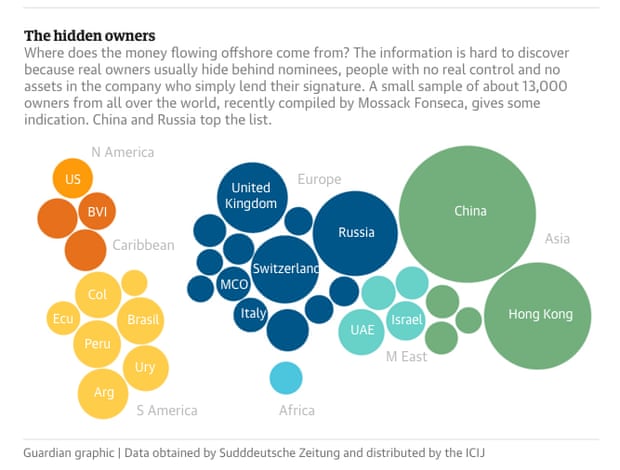
About 200 people with US addresses have so far been revealed as clients of Mossack Fonseca, the firm at the center of the Panama Papers leak. Compared with countries such as China, Switzerland, Russia and the United Kingdom, the number is small.

The anomaly may be because it’s so easy to create a vehicle to hide your money and your identity in the US that there’s no need to mess with Panama, according to Shruti Shah, vice-president of programs and operations at Transparency International, an anti-corruption organization.

“You don’t really have to go to Panama or other tax havens. They are not the only ones making it possible for corrupt officials and other criminals to launder their money. You can do it in every state in the US,” explained Shah.


“In every state in the US, you can incorporate an LLC – [a limited liability company] – or another legal entity and you don’t have to disclose who the beneficiary on it is. In fact, Delaware is so synonymous with anonymous companies and ghost corporations that it was named in Transparency International’s Unmask the Corrupt campaign as one of the most symbolic cases of corruption.”

The term tax haven usually evokes an image of some faraway place like Belize or the Cayman Islands. Yet in 2015, in a ranking of tax havens most attractive for those looking to hide assets, the US came in third – surpassing Cayman and Singapore. The two places that were even better suited as tax havens for the rich were Switzerland and Hong Kong, according to the Tax Justice Network that published the ranking.


What was Panama’s ranking? It was 10 spots behind the US, at 13.


Original Article

Panama Papers an external hack, not a leak from the inside: Mossack Fonseca files complaint

Panama City: The Panamanian lawyer at the center of a data leak scandal that has embarrassed a clutch of world leaders said on Tuesday his firm was a victim of a hack from outside the company, and has filed a complaint with state prosecutors.

Founding partner Ramon Fonseca said the firm, Mossack Fonseca, which specialises in setting up offshore companies, had broken no laws and that all its operations were legal. Nor had it ever destroyed any documents or helped anyone evade taxes or launder money, he added in an interview with Reuters.
Company emails, extracts of which were published in an investigation by the US-based International Consortium of Investigative Journalists and other media organisations, were "taken out of context" and misinterpreted, he added.


"We rule out an inside job. This is not a leak. This is a hack," Fonseca, 63, said at the company's headquarters in Panama City's business district. "We have a theory and we are following it," he added, without elaborating.


Ramon Fonseca, founding partner of law firm
 Mossack Fonseca. Reuters
"We have already made the relevant complaints to the Attorney General's office, and there is a government institution studying the issue," he added, flanked by two press advisers.

Governments across the world have begun investigating possible financial wrongdoing by the rich and powerful after the leak of more than 11.5 million documents, dubbed the "Panama Papers," from the law firm that span four decades.

The papers have revealed financial arrangements of prominent figures, including friends of Russian President Vladimir Putin, relatives of the prime ministers of Britain and Pakistan and Chinese President Xi Jinping, and the president of Ukraine.

On Tuesday, Iceland's prime minister, Sigmundur David Gunnlaugsson, resigned, becoming the first casualty of the leak.
"The (emails) were taken out of context," Fonseca said, denouncing what he called a "witch-hunt".

He lamented what he called journalistic activism and sensationalism, extolling his own investigative research credentials as a published novelist in Panama. He said he feared that his rivals could muscle in on their business following the leak.

"The only crime that has been proven is the hack," Fonseca said. "No one is talking about that. That is the story."
He said his company had a staff of around 500, 300 of which work in Panama, but declined to comment on his law firm's structure or franchises in other parts of the world.

Setting up a company might cost between about $700 and $1,000, he said, with a significant part of that fee going to the government. Mossack Fonseca has set up around 250,000 businesses over the past 40 years.

He added that it is cheaper to do business in Nevada. He said business rules have tightened and that his company has adhered to them.
"Fifteen years ago, due diligence didn't exist and they are judging us by other standards," Fonseca said.

France announced on Tuesday it would put the Central American nation back on its blacklist of uncooperative tax jurisdictions.


Alvaro Aleman, chief of staff to Panamanian President Juan Carlos Varela, told a news conference the government could respond with similar measures against France, or any other country that followed France's lead.


"This is a tropical storm, like the ones we have here in Panama where once it passes the sun will come out," Fonseca said. "I guarantee you that we will not be found guilty of anything."

Original Article

Tuesday, April 5, 2016

Giant Leak of Offshore Financial Records Exposes Global Array of Crime and Corruption

Millions of documents show heads of state, criminals and celebrities using secret hideaways in tax havens


In this story
  • Files reveal the offshore holdings of 140 politicians and public officials from around the world
  • Current and former world leaders in the data include prime ministers of Iceland and Pakistan, the president of Ukraine, and the king of Saudi Arabia
  • More than 214,000 offshore entities appear in the leak, connected to people in more than 200 countries and territories
  • Major banks have driven the creation of hard-to-trace companies in offshore havens
A massive leak of documents exposes the offshore holdings of 12 current and former world leaders and reveals how associates of Russian President Vladimir Putin secretly shuffled as much as $2 billion through banks and shadow companies.
The leak also provides details of the hidden financial dealings of 128 more politicians and public officials around the world.
The cache of 11.5 million records shows how a global industry of law firms and big banks sells financial secrecy to politicians, fraudsters and drug traffickers as well as billionaires, celebrities and sports stars.+


More than 500 banks, their subsidiaries and branches registered nearly 15,600 shell companies with Mossack Fonseca, according
Source - PanamaPapers 
These are among the findings of a yearlong investigation by the International Consortium of Investigative Journalists, German newspaper Süddeutsche Zeitung and more than 100 other news organizations.
The files expose offshore companies controlled by the prime ministers of Iceland and Pakistan, the king of Saudi Arabia and the children of the president of Azerbaijan.
They also include at least 33 people and companies blacklisted by the U.S. government because of evidence that they’d been involved in wrongdoing, such as doing business with Mexican drug lords, terrorist organizations like Hezbollah or rogue nations like North Korea and Iran.
One of those companies supplied fuel for the aircraft that the Syrian government used to bomb and kill thousands of its own citizens, U.S. authorities have charged.
“These findings show how deeply ingrained harmful practices and criminality are in the offshore world,” said Gabriel Zucman, an economist at the University of California, Berkeley and author of “The Hidden Wealth of Nations: The Scourge of Tax Havens.” Zucman, who was briefed on the media partners’ investigation, said the release of the leaked documents should prompt governments to seek “concrete sanctions” against jurisdictions and institutions that peddle offshore secrecy.


Messi in Documents


Argentine soccer player Lionel Messi.
Photo: Shutterstock / CP DC Press
The world’s best soccer player, Lionel Messi, is also found in the documents. The records show Messi and his father were owners of a Panama company: Mega Star Enterprises Inc. This adds a new name to the list of shell companies known to be linked to Messi. His offshore dealings are currently the target of a tax evasion case in Spain.

Whether they’re famous or unknown, Mossack Fonseca works aggressively to protect its clients’ secrets. In Nevada, the records show, the law firm tried to shield itself and its clients from the fallout from a legal action in U.S. District Court by removing paper records from its Las Vegas branch and having its tech gurus wipe electronic records from phones and computers.
The leaked files show the firm regularly offered to backdate documents to help its clients gain advantage in their financial affairs. It was so common that in 2007 an email exchange shows firm employees talking about establishing a price structure — clients would pay $8.75 for each month farther back in time that a corporate document would be backdated.


Crime of the century

Before dawn on Nov. 26, 1983, six robbers slipped into the Brink’s-Mat warehouse at London’s Heathrow Airport. The thugs tied up the security guards, doused them in gasoline, lit a match and threatened to set them afire unless they opened the warehouse’s vault. Inside, the thieves found nearly 7,000 gold bars, diamonds and cash.
articles/00Overview/160403-overview-08.jpg
Mossack Fonseca
Co-Founder Jürgen Mossack
“Thanks ever so much for your help. Have a nice Christmas,” one of the crooks said as they departed.
British media dubbed the heist the “Crime of the Century.” Much of the loot — including the cash reaped by melting the gold and selling it — was never recovered. Where the missing money went is a mystery that continues to fascinate students of England’s underworld.

Now documents within Mossack Fonseca’s files reveal that the law firm and its co-founder, Jürgen Mossack, may have helped the conspirators keep the spoils out of the hands of authorities by protecting a company tied to Gordon Parry, a London wheeler-dealer who laundered money for the Brink’s-Mat plotters.
Sixteen months after the robbery, the records show, Mossack Fonseca set up a Panama shell company called Feberion Inc. Jürgen Mossack was one the company’s three “nominee” directors, a term used in the business for stand-ins who control a company on paper but exercise no real authority over its activities.
An internal memo written by Mossack shows he was aware in 1986 that the company was “apparently involved in the management of money from the famous theft from Brink’s-Mat in London. The company itself has not been used illegally, but it could be that the company invested money through bank accounts and properties that was illegitimately sourced.”


Secrets and victims

Nick Kgopa’s father died when Nick was 14. His father’s workmates at a gold mine in northern South Africa said Nick’s dad had been killed by chemical exposure.
Nick and his mother and his younger brother, who is deaf, survived thanks to monthly checks from a fund for widows and orphans of mineworkers.
One day the payments stopped.

articles/00Overview/160403-overview-10.jpg
Gold miners in SA.

His family was one of many that lost out because of a $60 million investment fraud pulled off by South African businessmen. Prosecutors alleged that a group of individuals connected to an asset management company, Fidentia, had schemed to loot millions from investment funds — including the mineworkers’ death benefits pool that was supporting some 46,000 widows and orphans.

Mossack Fonseca’s leaked documents show that at least two of the men involved in the fraud used the Panama-based law firm to create offshore companies — and that Mossack Fonseca was willing to help one of the fraudsters protect his money even after authorities publicly linked him to the scandal.
Ponzi schemers and other fraudsters who bilk large numbers of victims often use offshore structures to pull of their schemes or hide the proceeds. The Fidentia case isn’t the only big-ticket fraud that appears in the files of Mossack Fonseca’s clients.
In Indonesia, for example, small investors claim a company incorporated by Mossack Fonseca in the British Virgin Islands was used to scam 3,500 people out of at least $150 million.
“We really need that money for our son’s education fee this April,” one Indonesian investor emailed Mossack Fonseca in April 2007 after payouts had stopped.
“You can give us any suggestion something we can do,” the investor asked in broken English after seeing Mossack Fonseca’s name on the investment fund’s advertising leaflet.
In the Fidentia case, Mossack Fonseca’s records show that one of the men later jailed in South Africa for his role in the fraud, Graham Maddock, paid Mossack Fonseca $59,000 in 2005 and 2006 to create two sets of offshore companies, including one called Fidentia North America. The law firm’s records say it gave him “the VIP service.”
Mossack Fonseca also created offshore structures for Steven Goodwin, a man that prosecutors later claimed had played an “instrumental role” within the Fidentia swindle. As the scandal broke in 2007, Goodwin flew to Australia, then to the U.S., where a Mossack Fonseca lawyer met with him at a luxury hotel in Manhattan to discuss his offshore holdings, the firm’s internal records show.
The firm official later wrote that he and Goodwin “spoke deeply” about the Fidentia scandal and that he had “convinced Goodwin to better protect” his offshore company’s assets by passing them to a third party.
In his memo, the firm official told colleagues that Goodwin wasn’t involved in the scandal “in any way whatsoever” — he was just “a victim of the circumstances.”
In April 2008, the FBI arrested Goodwin in Los Angeles and sent him back to South Africa, where he pleaded guilty to fraud and money laundering. He was sentenced to 10 years in prison.
A month after Goodwin’s sentencing, an employee at Mossack Fonseca suggested a plan for frustrating South African prosecutors who were expected to start digging into assets linked to Goodwin’s offshore company, Hamlyn Property LLP, which had been set up to buy real estate in South Africa.
The employee proposed having an accountant “prepare” audits for 2006 and 2007 “to try to prevent the prosecutor from taking actions against the entities behind Hamlyn.” He set off “prepare” in quote marks in his email.
It’s unclear whether the proposal was adopted.
Mossack Fonseca did not answer questions from ICIJ about its relationship with Goodwin. A representative for Goodwin told ICIJ that Goodwin “had nothing whatsoever” to do Fidentia’s collapse “or anything directly or indirectly to do with the 46,000 widows and orphans.”

Here are Video Playlist Link which covers it all : Panama Papers Playlist


Panama Papers firm under scrutiny once again


A dozen heads of state or former heads of state are included in the data leak from Panamanian law firm Mossack Fonseca .

The release of the Panama Papers may introduce most people to the secretive law firm that created offshore corporations that helped world leaders hide assets, but Mossack Fonseca was already well known to investigators and prosecutors around the world.


The Panama City firm, created in the 1980s through a merger of the law practices of German-born Jurgen Mossack and Panamanian lawyer Ramon Fonseca, has long been in the middle of investigations into money-laundering, corruption and government graft.

In January, one of the lead prosecutors in Brazil's ever-growing corruption scandal publicly called Mossack Fonseca "a big money launderer" involved in the wide-ranging probe. Last year, the firm became a central part of a lawsuit that alleged Argentina's former president created 123 shell companies in Las Vegas to hide stolen assets. And as far back as 2001, the U.S. State Department said the firm entered into an "awkward sharing agreement" with the tiny Pacific island of Niue to control foreign companies' ability to establish themselves there.

Panama Papers :Panama Law firm sanctions to blacklisted firms and individuals

The Panama law firm at the center of the biggest data leak in history had connections to dozens of firms and individuals on sanctions blacklists by the United States and international organizations, according to media groups that reviewed the documents.

Mossack Fonseca acted on behalf of at least 33 company shareholders, directors and other beneficiaries who were under sanctions by the U.S. Treasury Department, the European Union and the United Nations. They were targeted for a range of violations including having links to North Korea's nuclear weapons program, Russia's annexation of Ukraine's Crimea and human rights abuses in Syria.


While Mossack Fonseca worked with some of the companies and individuals prior to them being blacklisted, in some instances it continued to act on their behalf after they were placed on the blacklists, according to information found in the files.

The BBC identified one such firm, DCB Finance, which it said was jointly controlled by Kim Chol Sam, a North Korean official, and Nigel Cowie, a British national who was the chief executive of the sanctioned financial firm Daedong Credit Bank.

Mossack Fonseca said it "never knowingly" conducted business with sanctioned companies or individuals. However, it admitted it should have done more to determine where DCB Finance's owners were based — the North Korean capital Pyongyang as it turned out. Cowie was not personally sanctioned. DCB Finance was sanctioned for its alleged connections to a separate financial institution suspected of helping fund North Korea's nuclear program.

A sanction typically involves an official order to limit or stop trade and business with countries, companies or individuals who commit or are accused of offenses.

Original Source

The Panama Papers leak, explained with an adorable comic about piggy banks

It's easy to get confused by all the headlines about the Panama Papers, a massive 2.6-terabyte leak of documents that reveals a global web of corruption and tax avoidance. 

Here piggy banks help explain the main (and complicated-sounding) thing that was happening in Panama: foreigners setting up Panamanian shell companies to hold financial assets that obscure the identities of their real owners. We thought this analogy was quite fitting for a comic, so these illustrations explain the key issue at the heart of the Panama Papers scandal.

Below Video shows illustration of whole scam :


About the Panama Papers #panamapapers

Over a year ago, an anonymous source contacted the Süddeutsche Zeitung (SZ) and submitted encrypted internal documents from Mossack Fonseca, a Panamanian law firm that sells anonymous offshore companies around the world. These shell companies enable their owners to cover up their business dealings, no matter how shady.

First we see how to hide a Billion dollar according to panama papers scam


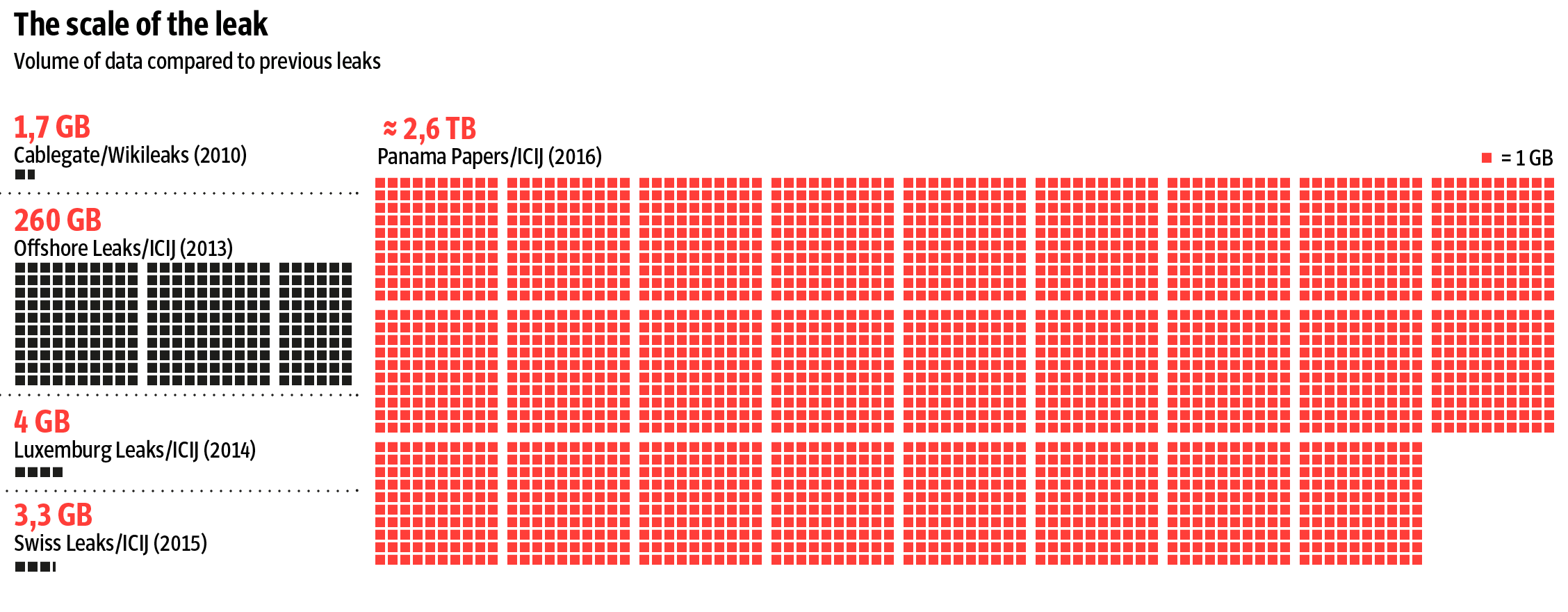
In the months that followed, the number of documents continued to grow far beyond the original leak. Ultimately, SZ acquired about 2.6 terabytes of data, making the leak the biggest that journalists had ever worked with. The source wanted neither financial compensation nor anything else in return, apart from a few security measures.


The data provides rare insights into a world that can only exist in the shadows. It proves how a global industry led by major banks, legal firms, and asset management companies secretly manages the estates of the world’s rich and famous: from politicians, Fifa officials, fraudsters and drug smugglers, to celebrities and professional athletes.


A group effort

The Süddeutsche Zeitung decided to analyze the data in cooperation with the International Consortium of Investigative Journalists (ICIJ). ICIJ had already coordinated the research for past projects that SZ was also involved in, among them Offshore Leaks, Lux Leaks, and Swiss Leaks. Panama Papers is the biggest-ever international cooperation of its kind. In the past 12 months, around 400 journalists from more than 100 media organizations in over 80 countries have taken part in researching the documents. These have included teams from the Guardian and the BBC in England, Le Monde in France, and La Nación in Argentina. In Germany, SZ journalists have cooperated with their colleagues from two public broadcasters, NDR and WDR. Journalists from the Swiss Sonntagszeitung and the Austrian weekly Falter have also worked on the project, as have their colleagues at ORF, Austria’s national public broadcaster. The international team initially met in Washington, Munich, Lillehammer and London to map out the research approach.

The data


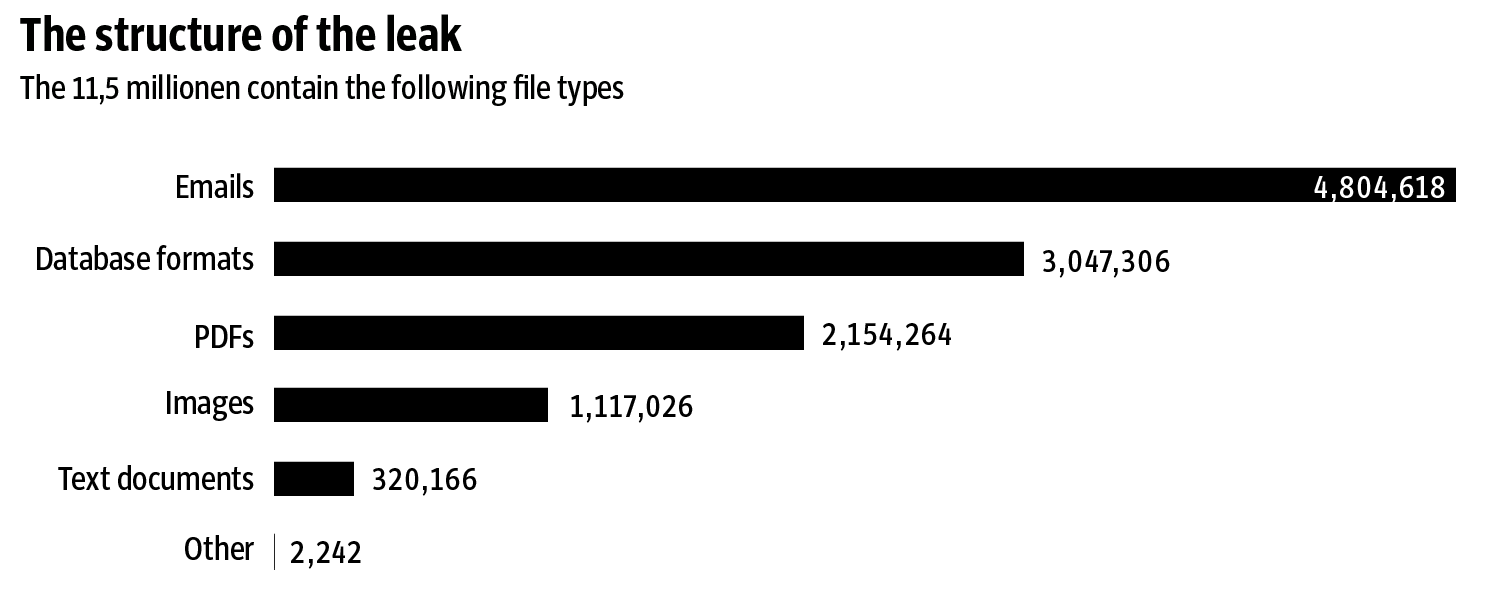
The Panama Papers include approximately 11.5 million documents – more than the combined total of the Wikileaks Cablegate, Offshore Leaks, Lux Leaks, and Swiss Leaks. The data primarily comprises e-mails, pdf files, photo files, and excerpts of an internal Mossack Fonseca database. It covers a period spanning from the 1970s to the spring of 2016. 

About data leak
About data leak


Moreover, the journalists crosschecked a large number of documents, including passport copies. About two years ago, a whistleblower had already sold internal Mossack Fonseca data to the German authorities, but the dataset was much older and smaller in scope: while it addressed a few hundred offshore companies, the Panama Papers provide data on some 214,000 companies. In the wake of the data purchase, last year investigators searched the homes and offices of about 100 people. The Commerzbank was also raided. As a consequence of their business dealings with Mossack Fonseca, Commerzbank, HSH Nordbank, and Hypovereinsbank agreed to pay fines of around 20 million euros, respectively. Since then, other countries have also acquired data from the initial smaller leak, among them the United States, the UK, and Iceland.


The system

The leaked data is structured as follows: Mossack Fonseca created a folder for each shell firm. Each folder contains e-mails, contracts, transcripts, and scanned documents. In some instances, there are several thousand pages of documentation. First, the data had to be systematically indexed to make searching through this sea of information possible. To this end, the Süddeutsche Zeitung used Nuix, the same program that international investigators work with. Süddeutsche Zeitung and ICIJ uploaded millions of documents onto high-performance computers. They applied optical character recognition (OCR) to transform data into machine-readable and easy to search files. The process turned images – such as scanned IDs and signed contracts – into searchable text. This was an important step: it enabled journalists to comb through as large a portion of the leak as possible using a simple search mask similar to Google.

The journalists compiled lists of important politicians, international criminals, and well-known professional athletes, among others. The digital processing made it possible to then search the leak for the names on these lists. The "party donations scandal" list contained 130 names, and the UN sanctions list more than 600. In just a few minutes, the powerful search algorithm compared the lists with the 11.5 million documents.

Structure of  Leak
Structure of  Leak

The research


For each name found, a detailed research process was initiated that posed the following questions: what is this person’s role in the network of companies? Where does the money come from? Where is it going? Is this structure legal?
Generally speaking, owning an offshore company is not illegal in itself. In fact, establishing an offshore company can be seen as a logical step for a broad range of business transactions. However, a look through the Panama Papers very quickly reveals that concealing the identities of the true company owners was the primary aim in the vast majority of cases. From the outset, the journalists had their work cut out for them. The providers of offshore companies – among them banks, lawyers, and investment advisors – often keep their clients’ names secret and use proxies. In turn, the proxies’ tracks then lead to heads of state, important officials, and millionaires. Over the course of the international project, journalists cooperated with one another to investigate thousands of leads: they examined evidence, studied contracts, and spoke with experts.

Among others, Mossack Fonsecas’ clients include criminals and members of various Mafia groups. The documents also expose bribery scandals and corrupt heads of state and government. The alleged offshore companies of twelve current and former heads of state make up one of the most spectacular parts of the leak, as do the links to other leaders, and to their families, closest advisors, and friends. The Panamanian law firm also counts almost 200 other politicians from around the globe among its clients, including a number of ministers.

The company

The company at the center of all these stories is Mossack Fonseca, a Panamanian provider of offshore companies with dozens of offices all over the world. It sells its shell firms in cities such as Zurich, London, and Hong Kong – in some instances at bargain prices. Clients can buy an anonymous company for as little as USD 1,000. However, at this price it is just an empty shell. For an extra fee, Mossack Fonseca provides a sham director and, if desired, conceals the company’s true shareholder. The result is an offshore company whose true purpose and ownership structure is indecipherable from the outside. Mossack Fonseca has founded, sold, and managed thousands of companies. The documents provide a detailed view of how Mossack Fonseca routinely accepts to engage in business activities that potentially violate sanctions, in addition to aiding and abetting tax evasion and money laundering.

About Süddeutsche Zeitung

Headquartered in Munich, Süddeutsche Zeitung (SZ) is one of Germany’s leading newspapers. SZ has a total readership of 4.4 million for its print and online media. Its investigative journalism team counts five people, three of which are members of the International Consortium of Investigative Journalists (ICIJ). The Süddeutsche Zeitunghas won a number of prestigious awards for its research work. Its team has cooperated with other media organizations on a number of projects, including Offshore Leaks, Swiss Leaks, and Lux Leaks, which ICIJ coordinated. At the beginning of 2015, an anonymous source began sending the Süddeutsche Zeitung data from Mossack Fonseca, a provider of offshore companies. This marked the beginning of the Panama Papers project.
The Süddeutsche Zeitung, in cooperation with the International Consortium for Investigative Journalists, sent Mossfon several written requests for comment. In response Mossfon sent two general statements, which can be viewed here.

Source : Original Article